
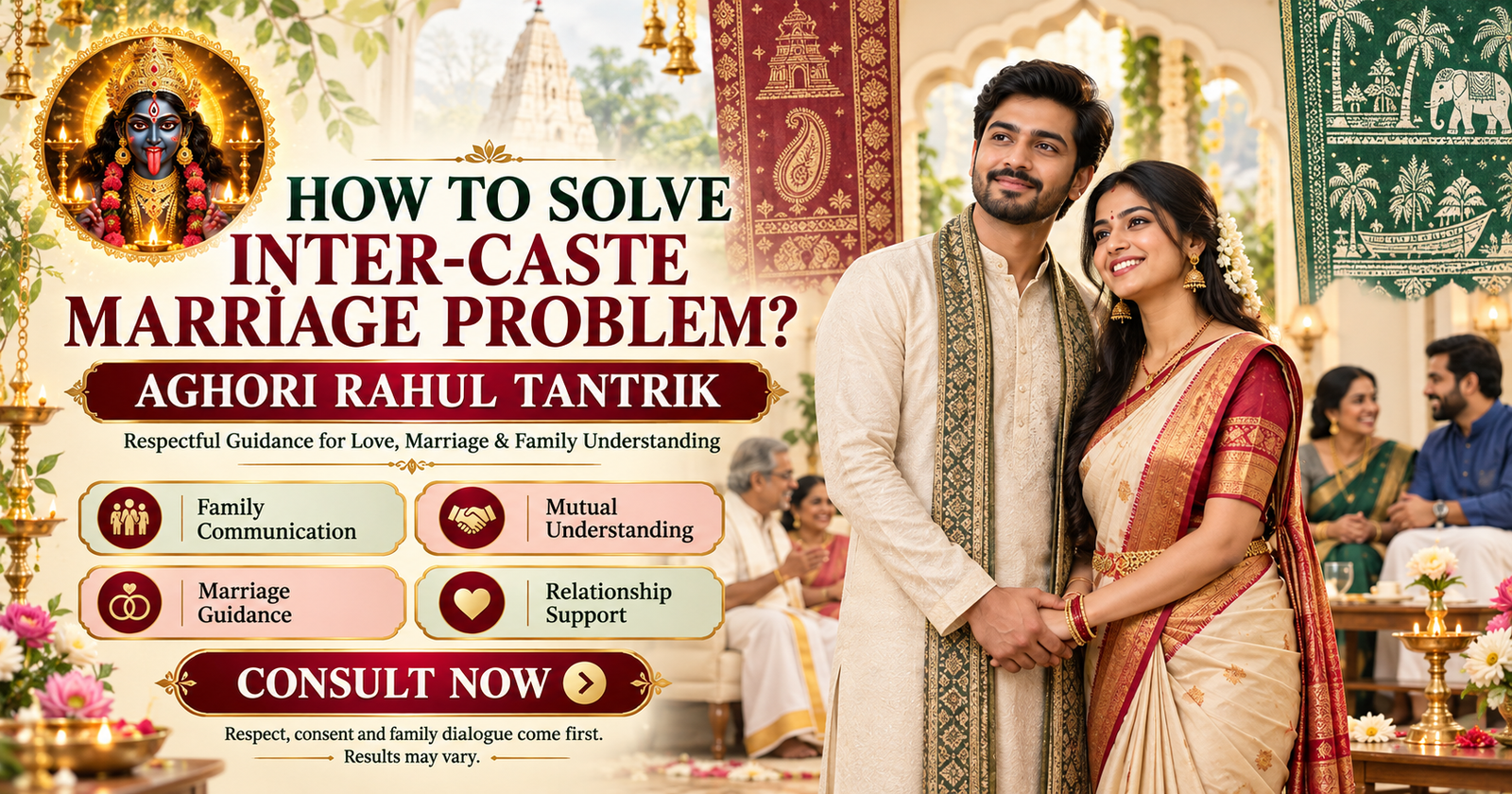
Marriage is an important decision involving two individuals as well as their families. When two people from different castes decide to marry, they may face resistance because of social traditions, family expectations, community pressure or concerns about cultural compatibility. These difficulties can make an otherwise happy relationship emotionally stressful.
Couples facing this situation often ask, “How to solve inter-caste marriage problem?” There is no single solution suitable for everyone. The right approach depends on the family’s concerns, the couple’s maturity, financial stability, cultural differences and willingness to communicate patiently.
Aghori Rahul Tantrik Ji offers traditional spiritual guidance for people facing inter-caste marriage obstacles, family opposition and relationship misunderstandings. Such guidance may provide emotional support and clarity, but practical communication, mutual consent and responsible planning remain essential.
Why Do Families Oppose Inter-Caste Marriage?
Understanding the reason behind family opposition is the first step toward resolving it. Parents may not always oppose the relationship because they dislike the partner. Their reaction may be influenced by fear, social pressure or uncertainty about the couple’s future.
Common reasons for opposition include:
- Concern about family reputation
- Fear of criticism from relatives or society
- Differences in traditions and customs
- Different food habits or lifestyles
- Worry about compatibility between families
- Concern about future children
- Financial or career uncertainty
- Lack of information about the partner
- Doubts about the seriousness of the relationship
- Religious or regional differences
- Fear that the marriage may not remain stable
- Pressure from extended family or community members
When couples understand the real concern, they can respond more effectively. Anger and arguments usually strengthen resistance, while calm and accurate information can gradually build trust.
Confirm That Both Partners Are Ready for Marriage
Before trying to convince family members, both individuals should confirm that they genuinely want marriage. A relationship may feel emotionally strong, but marriage also involves financial, social and practical responsibilities.
Discuss important questions such as:
- Are both partners freely choosing marriage?
- Are both legally eligible to marry?
- Do both understand the cultural differences involved?
- How will financial responsibilities be managed?
- Where will the couple live after marriage?
- Will both partners continue working?
- How will relationships with both families be maintained?
- What religious or cultural practices will be followed?
- How will future children be raised?
- How will disagreements be handled?
A couple that has honestly discussed these matters will be better prepared to answer family questions. It also demonstrates that the decision is thoughtful rather than impulsive.
Speak to Your Parents at the Right Time
Timing plays an important role when discussing an inter-caste relationship. Do not introduce the subject during an argument, family crisis or stressful occasion. Choose a peaceful time when your parents can listen without interruption.
Start the conversation gradually. Explain how long you have known your partner and why you consider the relationship suitable for marriage. Discuss the partner’s character, education, profession, family values and future plans.
Avoid beginning with statements such as, “I will marry this person whether you agree or not.” Such language may make parents feel excluded and defensive. Instead, tell them that their approval matters and that you want them to understand your decision.
Parents may not agree immediately. Give them time to process the information. Repeating the conversation calmly after a suitable interval can be more effective than demanding an instant answer.
Understand and Answer Their Concerns
When parents object, listen carefully instead of assuming that every concern is unfair. Ask them to explain what specifically worries them.
If they are concerned about financial stability, share a realistic financial plan. If they are worried about cultural differences, explain how both partners intend to respect each family’s customs. If their concern is the partner’s family, arrange a respectful meeting.
Some objections may be based on incomplete or incorrect information. Respond with facts rather than anger. Even if a concern appears unreasonable, a respectful answer is more likely to create progress.
A successful conversation is not about defeating the family in an argument. Its purpose is to reduce fear and build confidence in the couple’s decision.
Introduce Your Partner Respectfully
Parents may resist an inter-caste marriage because they know very little about the person their child wants to marry. A respectful introduction can help replace assumptions with real experience.
The first meeting should remain simple and comfortable. Avoid discussing every difficult issue immediately. Give both sides an opportunity to learn about each other’s personality, values and family background.
The partner should behave naturally and respectfully rather than trying too hard to impress. Parents often observe qualities such as patience, communication, responsibility and respect for elders.
If the first meeting does not go well, do not treat it as a final rejection. Families may need more than one interaction to become comfortable.
Seek Help from a Trusted Family Mediator
When direct discussions repeatedly become emotional, involve someone respected by both sides. This person may be an elder relative, family friend, teacher, counsellor or community member with a balanced outlook.
A suitable mediator can:
- Explain the couple’s intentions calmly
- Correct misunderstandings
- Encourage parents to meet the partner
- Keep conversations respectful
- Address practical concerns
- Reduce pressure from extended family
- Help both sides find common ground
Choose someone who supports peaceful dialogue rather than conflict. The mediator should not threaten, insult or pressure either family.
Create a Practical Plan for Married Life
Parents may become more receptive when they see that the couple has prepared for the future. A practical plan shows maturity and reduces uncertainty.
The plan should cover:
- Stable employment or income
- Monthly expenses and savings
- Housing arrangements
- Career goals for both partners
- Responsibilities toward parents
- Health and insurance planning
- Cultural and religious practices
- Handling festivals and family events
- Personal boundaries
- Conflict-resolution methods
Couples should not make unrealistic promises simply to gain approval. Honest planning creates a stronger foundation for marriage and prevents future disagreements.
Respect Cultural Differences
Inter-caste marriages often bring together different customs, languages, food habits and family expectations. These differences are not necessarily problems, but they require mutual respect.
Both partners should learn about each other’s traditions before marriage. Discuss which customs are important and how celebrations will be shared. Neither partner should be forced to abandon identity, language or family connections.
Respect should work in both directions. One family’s traditions should not automatically be treated as more important than the other’s. Couples can create a balanced household that honours meaningful practices from both backgrounds.
When families see that their culture will not be rejected, some of their resistance may decrease.
Avoid Threats and Emotional Blackmail
Threatening to leave home, harm oneself or permanently cut contact with the family can make the situation more dangerous. Emotional blackmail may produce temporary agreement but can seriously damage long-term relationships.
Similarly, parents should not use threats, confinement, violence or forced marriage to stop an adult’s voluntary decision. If either partner faces intimidation or immediate danger, personal safety must come first.
Stay connected with trusted people and keep important documents accessible. Seek assistance from qualified legal professionals, support organisations or local authorities when required.
Marriage should be based on free consent. Neither the couple nor their families should use coercion.
Spiritual Guidance for Inter-Caste Marriage Problems
Some couples seek spiritual or astrological guidance when family discussions repeatedly fail or unexplained delays continue. Such guidance may help individuals remain patient, reduce emotional negativity and approach the matter with a clearer mind.
Aghori Rahul Tantrik Ji provides traditional guidance for inter-caste marriage problems after understanding the individual circumstances. Where appropriate, prayers, mantra recitation, meditation or charitable actions may be suggested according to personal faith.
These practices should not be presented as a way to control family members or force a partner into marriage. Ethical spiritual guidance respects free will and focuses on peace, clarity and positive communication.
People facing broader relationship difficulties may also consult a Love Problem Solution Astrologer for personalized guidance regarding misunderstandings, emotional distance and marriage-related concerns.
Traditional Practices for Peace and Family Harmony
Individuals may follow simple spiritual practices according to their religious beliefs. In Hindu traditions, Lord Shiva and Goddess Parvati are regarded as symbols of devotion and marital harmony.
A person may offer water to Lord Shiva on Monday and pray for wisdom, patience and peaceful family communication. “Om Namah Shivaya” may be recited with a calm and sincere mind.
Some devotees worship Radha and Krishna for love and mutual understanding. Lighting a lamp, offering flowers and praying for harmony can provide emotional comfort.
Charitable actions, such as donating food or useful items to someone in need, may also be performed voluntarily. The intention should remain positive and compassionate.
Spiritual practices are matters of faith. They should complement honest communication and responsible action rather than replace them.
Horoscope Matching and Compatibility
Some families object to an inter-caste marriage because of horoscope compatibility. If both families believe in astrology, a detailed assessment by a responsible astrologer may help address their concerns.
Traditional compatibility analysis may consider emotional understanding, communication, temperament and marital indicators. However, no single score or planetary combination should determine the entire future of a relationship.
A favourable horoscope cannot guarantee a successful marriage, and an unfavourable score does not automatically mean that a marriage will fail. Trust, communication, emotional maturity and shared responsibility remain equally important.
If an astrological concern is identified, its meaning and limitations should be explained clearly. Fear-based claims and guaranteed remedies should be avoided.
Do Not Try to Control Your Partner or Family
People under emotional pressure may search for methods that claim to control a partner or influence parents against their will. This approach is unhealthy and can damage trust.
A relationship should progress because both individuals freely want it. Family approval should be pursued through communication, patience and understanding—not manipulation.
Ethical spiritual practices may focus on reducing personal anxiety and creating a peaceful environment for discussion. They cannot legitimately remove another person’s right to make an independent choice.
Be cautious of anyone promising instant control, guaranteed marriage or complete obedience within a fixed period.
Know When to Seek Professional Counselling
A qualified relationship or family counsellor may help when conversations repeatedly become hostile. Counselling provides a neutral space where the couple and family members can express their concerns more clearly.
Professional support may be helpful when:
- Both partners frequently argue about family pressure
- One partner is becoming uncertain about marriage
- Cultural differences remain unresolved
- Parents refuse every attempt at communication
- Emotional stress affects sleep or daily life
- The couple disagrees about future responsibilities
- Family members use guilt or threats
- Communication has completely stopped
Spiritual guidance and professional counselling can serve different purposes. Seeking counselling does not conflict with personal faith.
Understand Your Legal Rights and Responsibilities
Marriage laws and procedures depend on location, personal circumstances and the law applicable to the couple. Both individuals must meet the legal requirements and provide free consent.
Couples should verify current requirements through official government sources or a qualified local lawyer. Important matters may include age eligibility, identity documents, notice procedures, registration and protection against threats.
Do not rely solely on social-media posts or unverified websites for legal information. Laws and procedures can change, and individual situations may require professional advice.
If there is a risk of violence, forced marriage, unlawful confinement or harassment, contact the appropriate authorities or a qualified legal-support organisation promptly.
Practical Steps to Solve an Inter-Caste Marriage Problem
A balanced approach may include the following steps:
- Confirm that both partners freely want marriage.
- Discuss finances, careers, culture and family responsibilities.
- Identify the exact reason for parental opposition.
- Speak to parents calmly and at an appropriate time.
- Provide accurate information about the partner.
- Arrange a respectful meeting between both families.
- Involve a trusted mediator if communication fails.
- Give parents reasonable time to reconsider.
- Seek counselling when emotional pressure increases.
- Verify legal requirements through reliable sources.
- Prioritise safety if threats or violence occur.
- Use spiritual guidance only for positive and ethical purposes.
Patience is important, but patience does not mean tolerating abuse. Couples should distinguish between families needing time and situations involving genuine danger.
Frequently Asked Questions
Can parents eventually agree to an inter-caste marriage?
Many parents become more accepting after receiving accurate information, meeting the partner and seeing a responsible future plan. However, every family and situation is different.
Should couples run away and marry?
Leaving without preparation can create legal, financial and safety complications. Adults should first consider peaceful communication, mediation and qualified legal guidance. If there is an immediate safety risk, contact appropriate support services.
Can astrology remove inter-caste marriage obstacles?
Astrology and spiritual practices are matters of traditional belief. They may provide emotional guidance, but they cannot guarantee approval or marriage. Practical communication and consent remain essential.
How long should couples wait for family approval?
There is no universal timeline. Couples should allow reasonable time while continuing respectful communication, but they must also consider their circumstances, safety and future plans.
What if one partner changes their mind?
That decision must be respected. Marriage requires the free and continuing consent of both individuals. Pressure, threats or manipulation are unacceptable.
Consult Aghori Rahul Tantrik Ji
If family opposition, misunderstandings or repeated delays are affecting your inter-caste relationship, Aghori Rahul Tantrik Ji offers personalized spiritual guidance based on traditional beliefs.
He seeks to understand the couple’s circumstances before suggesting any spiritual practice. The objective is to support emotional clarity, patience and peaceful family communication while respecting consent and personal freedom.
The answer to “How to solve inter-caste marriage problem?” usually lies in a balanced combination of honest communication, responsible preparation, family mediation, professional support and positive spiritual faith.
A successful marriage is not created by winning an argument. It is built through trust, mutual respect, shared responsibility and the willingness of both partners to stand together maturely.